


Page 12 - Demo
P. 12
opinion thoughtSPACE
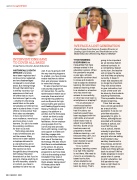
    WE FACE A LOST GENERATION
Vivian Onano from Kenya is Founder/Director at Leading Light Initiative, and Youth Adviser at the Global Education Monitoring Report, UNESCO
‘THIS PANDEMIC
IS EXPOSING the inequalities that have always existed in the education system. When the pandemic erupted
a year ago, schools across the continent had to close and students had to adapt to distance learning. But what does distance learning mean to a student or a teacher who has never had access to connectivity, or who has never seen a smartphone or a laptop?
‘I’m an advocate of continuous teacher development. If we’d had it in place, our teachers would have been equipped with the right skills, and would have known how to adjust to something like this. Some of our teachers were not prepared to handle distance learning – not because they can’t, but because they hadn’t been trained or given the tools to do so.
‘In our current systems, learning comes to a halt if the teacher
is not there. We need to move to a competency- based curriculum,
where students can learn on their own and learn by doing. That’s
going to be important
as we develop hybrid national curricula. In
a competency-based curriculum, the teacher will not play the same role that they are playing currently. It doesn’t mean that teachers will no longer be important. They will still be there
to give instruction, but much of the work will be done by the students teaching themselves. This is possible through distance learning.
‘I fear that we may lose a whole generation as a result of this pandemic if we do not prioritise education, especially for girls. In Kenya, schoolgirls are provided with sanitary towels at school, but now that they are
not at school, there’s nobody to give them sanitary towels. There are girls who are selling their bodies to buy sanitary towels and in the process, some fall pregnant. How do you make sure those girls go back to school? We’ve made progress in recent years when it comes
to girls’ education, but this pandemic may
take us right back to where we were.’
  INTERVENTIONS HAVE TO COVER ALL BASES
Craig Paxton, Director, Axium Education
‘HISTORICALLY, SOUTH AFRICA’S rural areas
have been neglected and continue to be neglected, and are disadvantaged compared to most urban areas. But viewing things through that deficit lens
is entirely incorrect. Our experience is that rural
life offers kids so much
that kids can’t get in a city
– whether it’s the strong social fabric or the quite remarkable commitment we see in students there. A rural child is not less clever than their urban counterparts.
In fact, we tend to find
more resilience, more focus and more drive in rural learners. Our job is to create the enabling conditions
for them to do well.
‘Technology solutions
in and of themselves are
not the answer. Many
times we’ve seen tablets
or laptops delivered to
a rural school to just sit there without being used. We need to be more thoughtful about introducing technology. Education theorists tell us that if you’re going to change anything to do with teachers, students or content, you have to address the other two as
well. If you’re going to shift the way teaching happens to a tablet, you have to also enable teachers to deliver that, and empower students to make that change.
‘It’s also important to have a structured programme
of intervention. To use the tablet-based initiative as an example, there are lots of strong learning platforms, such as Siyavula for high- school maths and science and Reading Eggs for early literacy. Hardware is one aspect, the platform is another, but the third piece – which we think is really important – is the social facilitators. Axium employs young people from the community and provides them with training, coaching and support to make sure that they engage kids
well and that they monitor their use of the learning technology. We also ensure that there is embeddedness in the school. It’s all very well to have an additional programme, but how does it fit into the existing school timetable? How does it connect with the learning that’s already taking place? All those pieces have
to be thought about.’
10 | ISSUE 1 2021


