


Page 17 - Demo
P. 17
had powerful impact.
As with protests where ordinary citizens are able
to hold elected officials accountable, social media allows ordinary social-media users to contact brands
and public figures and hold them accountable for their messages and their actions.
WHAT ARE THE RISKS
OF ONLINE PROTEST? Taking protesting online
also means that everyone
is at risk of being cancelled. Wikipedia defines cancel culture as ‘the practice of withdrawing support for (or “cancelling”) public figures and companies after they have done or said something considered objectionable
or offensive’. Cancelling
is often an economic step
– refusing to support a brand or company or public figure by no longer buying their products or watching their films – but it can also be performed by calling people out, in other words, by naming and shaming.
In South Africa, online protests around racist Tresemmé advertisements on the Clicks website led to the removal of the brand’s products from stores around the country. It also led to
the destruction of property at many Clicks stores, the harassment of Clicks staff and violence – all directed at Clicks, when the source of the advertisement
was, in fact, Unilever. Globally, recent examples
include the #MeToo and #TimesUp movements. Both started online and both resulted in powerful men being publicly shamed and held accountable in court. Naming and shaming can thus be an effective tool when there is agreement
or evidence that a wrong has been committed. But what happens when
someone’s words have been misinterpreted? Is there any room online for making a mistake? Can you shame someone into changing their mind?
Author and addictions counsellor Desiree-Anne Martin thinks not. ‘Shame
is a barrier to interpersonal connection and connection is vital in order to undergo any significant, sustainable change,’ she says. She is not alone in thinking this. In her 2020 essay in Living While Feminist, Tiffany Kagure Mugo writes, ‘I have seen people use public platforms for conversations and confrontation that could have happened behind closed doors. In privacy, those conversations could have allowed for both parties to grow ... Instead, in public... this does little but raise the profile of the person doing the calling out, while shaming the person being called out.’ In addition, as author Jon Ronson points out, there
can also be ‘a disconnect between the severity of
the crime and the gleeful savagery of the punishment’.
Cancel culture can be used to shame someone into silence and can serve as a public reminder for others not to express similar ideas. It rarely leaves room for dialogue, for an admission
of guilt or growth, nor does it leave much room for nuance. Some have suggested
that this online silencing goes so far as to become censorship by public opinion.
There are, of course, instances where someone is guilty of deliberately saying terrible things online, for instance things that constitute hate speech or are racist or sexist. Many times, such things are themselves said in order to silence another group. At the same time it is safe to
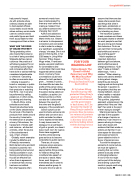
FOR YOUR READING LIST
Unfree Speech: The Threat to Global Democracy and Why We Must Act, Now by Joshua Wong (Penguin Random House South Africa)
At 14, Joshua Wong founded a group that protested Hong Kong’s planned ‘pro-Beijing’ school curriculum and got the government to back down. At 17, he became the leader of Hong Kong’s umbrella protests. Now 24, Joshua is a veteran of protests and activism, and this is his story in his own words, including letters written during various stints in prison.
assume that there are also cases where people have said things that were in poor taste, problematic or offensive without realising it or intending any harm.
The important question
to ask ourselves as citizens and digital citizens is whether we want people to see that they are wrong and change their behaviour. Or do we
just want them to feel guilty and terrible and never to
say anything again?
Martin explains an important distinction between guilt and shame, and its effectiveness at changing behaviour. ‘Guilt says “I made a mistake”; shame says, “I am a mistake.’” When shaming tactics are used to attempt to bring about change, [what they are doing is] implying and reinforcing that the person in question is the problem; that they are morally deficient, devoid
of any healthy or valuable traits, useless, hopeless. This punitive, judgmental approach underscores in the person that if they are “that bad” then what is the point of even trying to change?’
Shaming someone, then, can lead to the opposite
of a change of opinion or behaviour. It can result in a person refusing to change, even when faced with evidence that their words or actions are harmful. It can close space for discussion, and cause someone to ignore objective truths in favour of personal ones.
To avoid the dangerous elements of cancel culture, we must be vigilant in ensuring that our online protest is actually aimed at changing behaviour.
If it isn’t, then we might
just be part of the bullying and shaming culture that results in people continuing to behave badly. M
thought SPACE activism
  ISSUE 1 2021 | 15
ILLUSTRATION: GALLO IMAGES/GETTY IMAGES. PHOTO: SUPPLIED


