


Page 34 - Nine Yards Magazine 2021/2022 - Old Mutual Corporate
P. 34
keep going know-how
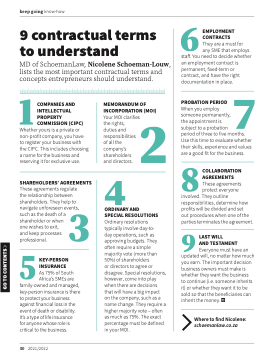
 9 contractual terms to understand
MD of SchoemanLaw, Nicolene Schoeman-Louw, lists the most important contractual terms and concepts entrepreneurs should understand.
EMPLOYMENT CONTRACTS
They are a must for any SME that employs
staff. You need to decide whether an employment contract is permanent, fixed-term or contract, and have the right documentation in place.
PROBATION PERIOD
When you employ
someone permanently,
the appointment is
subject to a probation
period of three to five months. Use this time to evaluate whether their skills, experience and values are a good fit for the business.
COLLABORATION AGREEMENTS These agreements protect everyone
involved. They outline responsibilities, determine how profits will be divided and set
out procedures when one of the parties terminates the agreement.
LAST WILL
AND TESTAMENT Everyone must have an
updated will, no matter how much you earn. The important decision business owners must make is whether they want the business to continue (i.e. someone inherits it) or whether they want it to be sold so that the beneficiaries can inherit the money.
Where to find Nicolene:
schoemanlaw.co.za
      COMPANIES AND INTELLECTUAL PROPERTY COMMISSION (CIPC)
Whether yours is a private or non-profit company, you have to register your business with the CIPC. This includes choosing a name for the business and reserving it for exclusive use.
SHAREHOLDERS’ AGREEMENTS These agreements regulate
the relationship between shareholders. They help to navigate unforeseen events,
such as the death of a shareholder or when one wishes to exit, and keep processes professional.
KEY-PERSON INSURANCE
As 75% of South Africa’s SMEs are
family-owned and managed, key-person insurance is there to protect your business against financial loss in the event of death or disability. It’s a type of life insurance
for anyone whose role is critical to the business.
MEMORANDUM OF INCORPORATION (MOI) Your MOI clarifies
the rights,
duties and responsibilities of all the company’s shareholders and directors.
ORDINARY AND
SPECIAL RESOLUTIONS Ordinary resolutions typically involve day-to-
day operations, such as approving budgets. They often require a simple majority vote (more than 50%) of shareholders
or directors to agree or disagree. Special resolutions, however, come into play when there are decisions that will have a big impact on the company, such as a name change. They require a higher majority vote – often as much as 75%. The exact percentage must be defined in your MOI.
            GO TO CONTENTS
  30 2021/2022


